visit our testimonials page to see what students have said
About
Us
Biography
of Master Stephen Hwa
Stephen
Hwa was born in Jiangsu, China in 1933
and emigrated to the U.S. in 1957 for
graduate study. After receiving a doctorate
degree in engineering, he worked for
several companies, including Xerox
in Rochester, NY.
In
1974, Hwa took his first Tai Chi class with Grand
Master Young Wabu, a student of legendary master
Wu Chien Chuan. Impressed by Young’s teaching
and what Tai Chi could offer, Hwa made Tai Chi
a part of his life and began his avid study of
the discipline. In addition to learning from
Young Wabu, he also participated in classes taught
by Young’s daughter, Master Sonia Young.
Hwa
became fascinated with the underlying principles
that unified Tai Chi’s seemingly complex
movements. He has distilled the knowledge he
gained into the fundamental principles of classical
Tai Chi with its unifying principle of Internal
Discipline.
An
article about his teaching, "Learn The Internal
Dynamics of T’ai Chi", was written
by E. Marie Koepsell and published in T’ai
Chi magazine, Vol. 22, No. 4, 30 (Aug. 1998).
Hwa
teaches Tai Chi to students and staff members
at the University of Buffalo and also leads several
Tai Chi classes at USA Karate in Fairport, New
York.
Biography
of Grand Master Young Wabu
Young
Wabu was born in Guangdong, China, in
1904. After attending college in Hong
Kong, he established residence there
and worked in the import business. Since
a very early age, he had shown a great
interest in and aptitude for martial
arts. By his twenties, he had already
mastered ten different types of external
martial arts and established a reputation
in the field.
In
1937, with the outbreak of war with Japan, the
legendary Tai Chi Master Wu Chien Chuan left
Shanghai, seeking the safety of Hong Kong. Young
was then in charge of the martial art section
of the South China Athletic Association and organizing
a martial art exhibit. Hearing about Wu’s
arrival, Young invited Wu to participate in the
exhibit. The two men immediately found much in
common. Young tested his martial art skills with
Wu and found that he was completely dominated
by Wu and unable to maintain his balance, no
matter which kind of external martial art he
used. At that point, Young gave up all he had
learned before and became Wu’s student.
He started from the very beginning.
Young Wabu & Wu
Chien Chuan
Young
remembers the difficulty in trying to forget
the deeply ingrained external martial arts he
had learned and switch to the very different
internal martial art. He dedicated four years
of fulltime study with Wu before Wu returned
to Shanghai in 1941. For a period, Wu stayed
with him at his residence with the teaching and
learning sessions going on day and night, everyday.
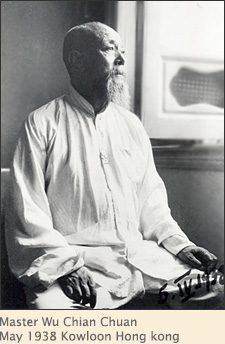
The photograph of him and Wu was taken at his
home in July 1938.
During
that time, Wu bestowed upon Young another one
of Wu’s treasure-the art of treating human
ailment with internal energy, or Qi. The foundation
of this treatment technique are internal energy,
techniques of imparting energy (broad) and penetrating
energy (focused). All these are originated from
Tai Chi’s internal training and its martial
art application training. Young excelled in the
learning of this art.
Young
started offering daily Tai Chi classes in Hong
Kong. He was devoted to the cause of propagating
Wu’s teaching. Later, he also taught classes
in the U.S. when he would come to visit his daughter
Sonia in Rochester, New York, for part of the
year. A dedicated and insightful teacher, he
melded modern thinking with traditional ways
to make his lessons accessible to his students.
His teaching emphasizes the building of a solid
foundation with rigorous Tai Chi form practice.
At
the same time, Young began to treat his close
friends’ ailments with the treatment techniques
learned from Wu. The results were very successful,
and he started to build a reputation based on
his healing ability. He turned that skill into
a full-time profession with a very busy practice.
Even high-level officials in the Hong Kong government
sought help from him.
Before
Hong Kong reverted back to China, Young emigrated
to the U.S. and retired there, although he still
teaches a few students to this day. Now in his
nineties, he still has the complexion and energy
of a young person. The picture of him was taken
in June 2002 at the age of 98.
Grand Master Young Wabu passed away on April 18, 2005 at age of 101 in Rochester, NY.
Biography
of Master Sonia Young
Sonia
Young, the eldest child of Young Wabu,
was born prematurely with severe complications.
Doctors did not expect her to survive
for long. When Wu Chien Chuan came to
stay at her house, she was about a year
and half old. She showed an interest
in being in the room where her father
and Wu practiced Tai Chi.
One
day Wu told Young that he would cure his daughter
and that he also wanted to teach Young his treatment
technique. So Sonia’s condition became
the first example Wu used to explain the art
of treatment to Young. To this day, she is convinced
that Wu had rescued her from her critical health
problems.
At
the age of three and half, Sonia began to learn
the Tai Chi form from her father, who wanted
to strengthen her health. She remembers that
the enjoyable sensation of practicing Tai Chi
enticed her to continue learning it even as a
young child. She not only built a solid foundation
in Tai Chi form practice but also developed into
a healthy and athletic girl with an interest
in the martial art applications of Tai Chi.
As
a result, at age eleven, she was enrolled in
the Hong Kong Chien Chuan T’ai Chi Ch’uan
Academy under the tutelage of Master Wu Kung
Yi, son of Wu Chien Chuan. At that time, Tai
Chi martial art applications were a serious pursuit.
Intense and full-out sparring were frequent and
sometimes resulted in injury. Sonia still marvels
at Wu Kung Yi’s ability to heal his students’ injuries.
Wu once commented that any master leading a class
as this should have the ability to treat and
heal.
Sonia
remained Wu’s student until she left for
nursing school at the age of seventeen. After
she graduated from the University of Minnesota
with a degree in pathology, she moved to Rochester,
New York, with her family. Her fascination with
the art of treatment continued. Long-term visits
from her father provided her with extended periods
to learn this art from him.
In
the mid nineteen seventies, she started to hold
Tai Chi classes and tried her hand at treatment.
By the eighties, her reputation in treatment
and healing had attracted wide attention. Her
clients included individuals as well as school
sports groups. She also acted as a consultant
on alternative treatments to the Mayo Clinic.
Sonia is now dedicated to her practice full-time
and no longer takes on new Tai Chi students.